Lingopure blog
20 Essential English Phrases for Working With International Teams
You may be excellent at your job, consistently meet deadlines and know your collaboration tools inside out. Yet speaking up during a meeting with international colleagues can still feel challenging.
Working remotely with a global team requires more than reading and understanding English. You also need to give progress updates, explain problems, ask for clarification and agree on next steps.
Here are 20 practical English phrases for remote work, particularly useful for professionals in IT, Marketing, Data, Product and other internationally connected roles.
1. English phrases for starting online meetings
1. "Can everyone see my screen?"
Use this when you begin sharing a document, dashboard or presentation.
It is a simple but essential expression in virtual meetings.
2. "Could you give us a quick update?"
A polite way to ask a teammate about progress without making the conversation sound demanding.
3. "To make sure we're aligned, let's review the priorities."
This is useful when several people are working towards the same deadline.
"Aligned" means that everyone shares the same understanding of the priorities or plan.
4. "Can we clarify the goal for today's call?"
Use this when the purpose of a meeting is unclear or when you want to keep the discussion focused.
5. "I'll quickly walk you through the main points."
A natural opening when presenting a product, explaining a report or introducing project updates.
"Walk someone through" means to explain something step by step.
2. English phrases for giving progress updates
Clear status updates are especially important when you work remotely and colleagues cannot always ask you questions in person.
6. "Yesterday I worked on the API integration. Today I'll focus on testing."
This is a useful structure for daily stand-ups and project check-ins.
You can adapt it to virtually any role.
7. "The main blocker is that we're still waiting for client feedback."
Use "blocker" to describe an issue that prevents progress.
Identify the obstacle clearly instead of saying only that there is a problem.
8. "I'm on track to complete the task by Friday."
This tells your team that work is progressing according to plan.
You can also say, "We're on track to meet the deadline."
9. "I need input from the design team before moving forward."
This expression helps communicate dependencies without blaming another team.
It also makes the next action clear.
10. "I've flagged a potential risk with the current timeline."
"Flagging a risk" means drawing attention to a concern before it becomes a larger problem.
It is especially useful in project management and client communication.
3. English phrases for asking questions and clarifying requirements
Professionals sometimes hesitate to ask questions because they worry about their English.
In reality, clarification is an important part of effective workplace communication.
11. "Could you clarify what you mean by that?"
Use this when you need someone to explain an idea or instruction in greater detail.
It is polite, direct and suitable for most professional settings.
12. "Just to confirm, are we prioritising the mobile version?"
"Just to confirm" is a natural phrase when checking that you have understood a decision correctly.
13. "Would you mind repeating the last point?"
A courteous way to ask someone to repeat information you may have missed.
You can also ask, "Could you say that again, please?"
14. "Here's how I understand the requirement."
Follow this phrase with your own explanation of the task.
It gives the other person a chance to correct misunderstandings before work begins.
15. "Can we capture that decision in writing?"
This is particularly useful for distributed teams working across different time zones.
Written decisions make it easier to maintain clarity in email, Slack or Teams conversations.
4. English phrases for discussing deadlines and next steps
16. "I can deliver this by Thursday, provided we receive the final requirements today."
This lets you communicate a commitment and the condition required to meet it.
"Provided" means "on the condition that".
17. "I may need an extra day because the scope has changed."
Use this when a change in requirements affects your timeline.
Whenever possible, follow it with a realistic revised delivery date.
18. "Let's agree on the next steps."
A practical phrase for moving a discussion towards decisions and action.
It works particularly well near the end of a meeting.
19. "I'll share a short summary after the call."
This shows that you will document important outcomes and make information available to others.
20. "Please let me know if I've missed anything."
A useful closing sentence for meeting summaries, project updates and follow-up emails.
It invites colleagues to correct or complete the information.
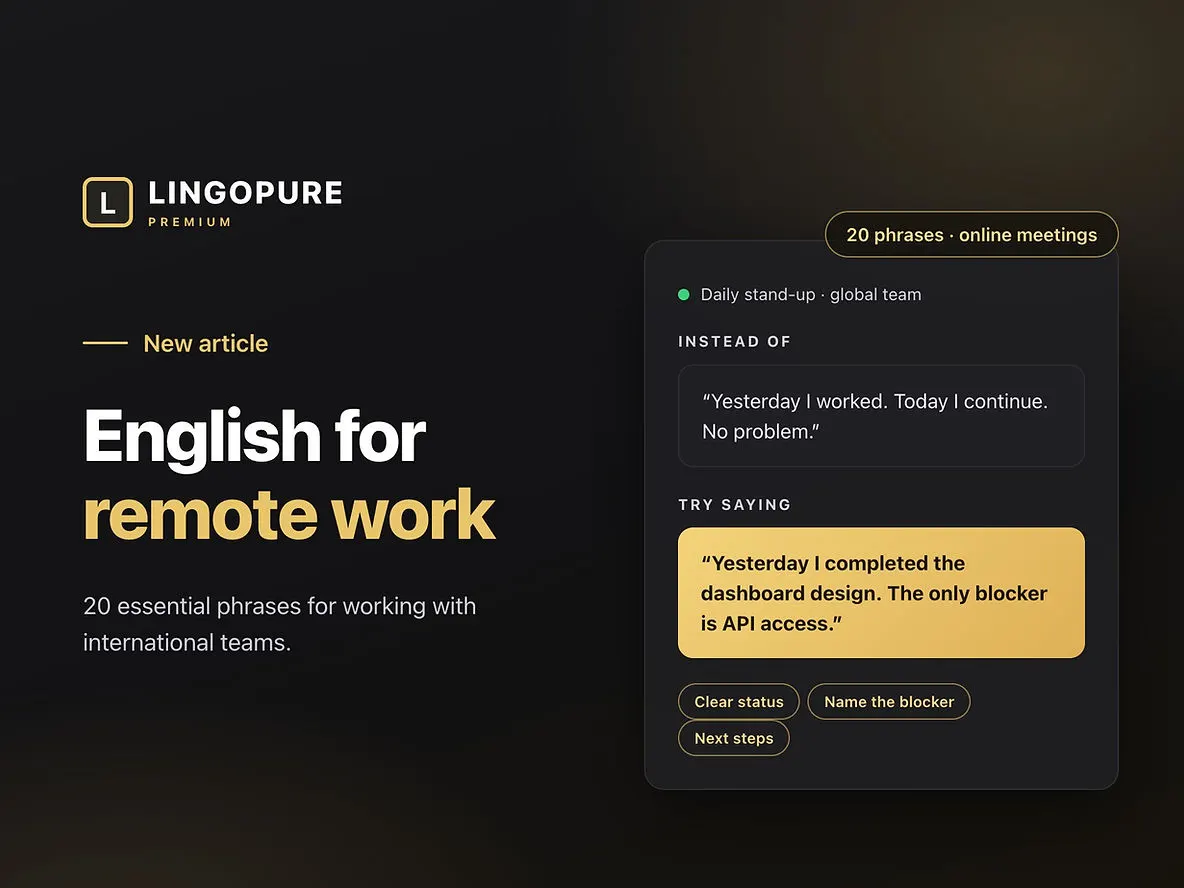
Example: Giving a clear daily stand-up update
Instead of saying:
"Yesterday I worked. Today I continue. No problem."
Try something more specific:
"Yesterday, I completed the initial dashboard design. Today, I'll work on the data integration. The only blocker is that I'm waiting for access to the reporting API. Once I receive it, I can continue with testing."
This update tells your colleagues:
- What has been completed.
- What is happening next.
- What is preventing progress.
- What is needed to move forward.
Notice that the language is not particularly complicated. The value comes from the clarity of the message.
How to improve your English for remote work
Practise communication situations, not isolated vocabulary
Focus on the situations you actually experience: daily meetings, project reviews, customer calls and written updates.
A phrase becomes more useful when you can apply it to a real task.
Build a personal library of workplace expressions
If you are a Data Analyst, collect phrases that help you explain trends, present insights and recommend actions.
If you are a software developer, focus on describing technical decisions, discussing blockers and explaining delivery risks.
The goal is to build language around your responsibilities.
Practise speaking out loud
Recognising a phrase when you read it is different from being able to use it during a meeting.
Record yourself, listen back and practise expressing the same idea in different ways. This can help you become more flexible when conversations take an unexpected direction.
Frequently asked questions
Do I need fluent English to work remotely for an international company?
Not every remote position requires the same level of English. Requirements depend on the role, the employer and how the team collaborates. However, the ability to communicate clearly is often valuable when working with international colleagues and clients.
Should I focus on conversational English or industry-specific English?
Both matter. Start with the communication tasks you perform regularly, then develop the terminology and expressions that are specific to your profession.
For many professionals, the most effective practice combines workplace communication with job-related situations.
Make your expertise easier to understand
Your work may already speak for itself. But in an international team, how you explain that work can influence how effectively you collaborate.
LingoPure offers role-focused Business English programmes built around real workplace scenarios, from project meetings and technical discussions to presenting ideas and communicating with clients.
Build the English you need at work
Start with a free assessment and identify the communication situations that deserve focused practice.
Sign up