Lingopure blog
10 Common English Interview Questions and How to Answer Them
You have the experience, the technical skills and a CV that matches the role. But when an interview switches to English, explaining your achievements can suddenly feel much harder.
This is a familiar challenge for professionals applying to international companies or remote positions.
The good news is that you do not need to memorise complicated answers. You need to understand what interviewers are asking, organise your thoughts and practise communicating your experience clearly.
Here are 10 common English interview questions, with sample answers you can adapt to your own professional background.
1. Tell me about yourself
This is often the first question in a job interview. Recruiters are not asking you to repeat your entire CV. They want a concise introduction to your professional background and why you are a good fit.
Sample answer:
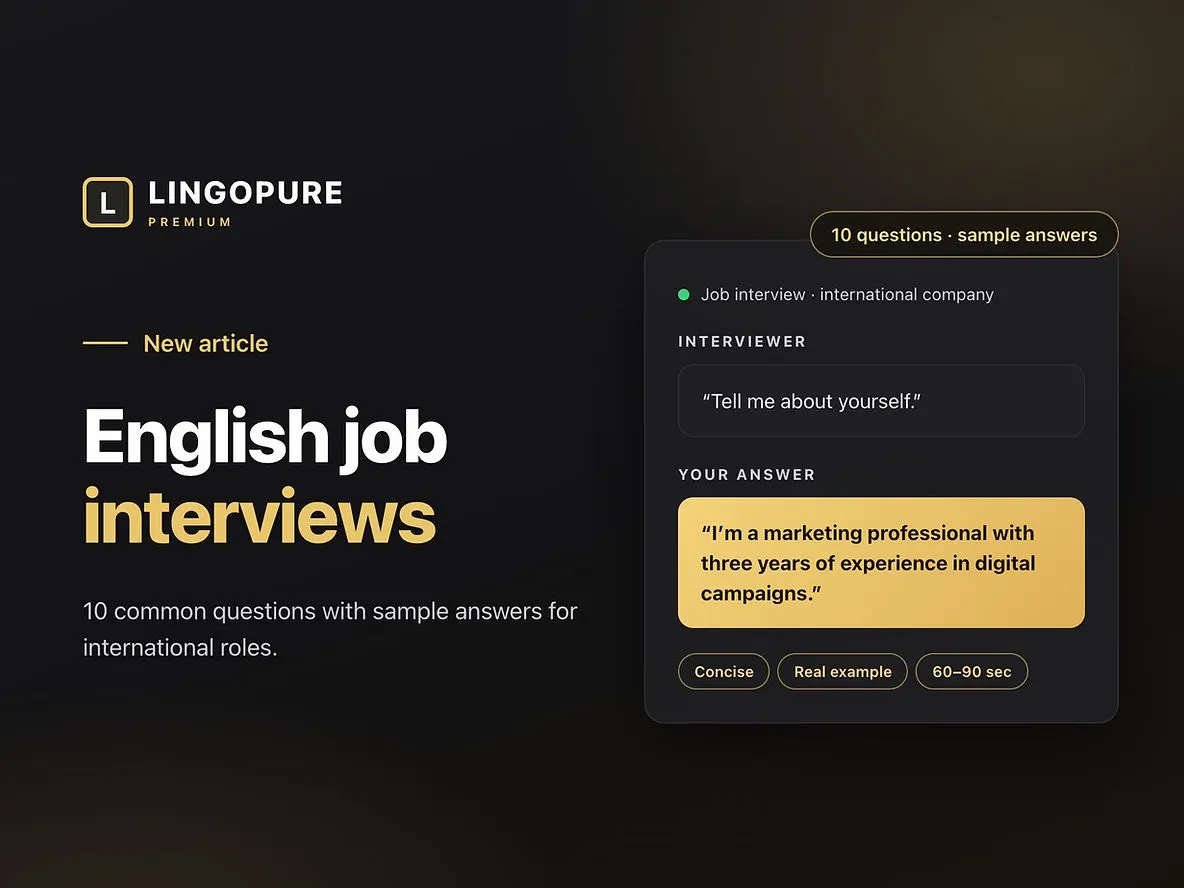
"I'm a marketing professional with three years of experience in digital campaigns and content strategy. In my current role, I focus on improving campaign performance and working with cross-functional teams. I'm now looking for an opportunity to contribute to a more international environment."
Tip: Structure your answer around your experience, key strengths and career direction. Aim for approximately 60–90 seconds.
2. Why do you want to work for our company?
Interviewers want to understand whether your interest in the role is genuine.
Sample answer:
"I'm interested in your company's focus on innovation and international collaboration. I believe my experience in project management would allow me to contribute to your team while continuing to develop my skills."
Tip: Research the company's products, customers and business direction. Connect one specific aspect of the company to your experience or career goals.
3. What are your greatest strengths?
Choose a strength that is relevant to the position, then explain how it helps you perform at work.
Sample answer:
"One of my strengths is problem-solving. When a project faces unexpected challenges, I focus on identifying the root cause and finding practical solutions."
Whenever possible, support your answer with a genuine example.
4. What is your biggest weakness?
You do not need to disguise a strength as a weakness. A thoughtful answer shows self-awareness and a willingness to improve.
Sample answer:
"I used to spend too much time perfecting small details. I've been improving this by setting clearer priorities and focusing on tasks that have the greatest impact."
Avoid choosing a weakness that directly undermines your ability to perform the job's essential responsibilities.
5. Tell me about a challenge you faced at work
Behavioural interview questions ask you to demonstrate how you handled a real situation.
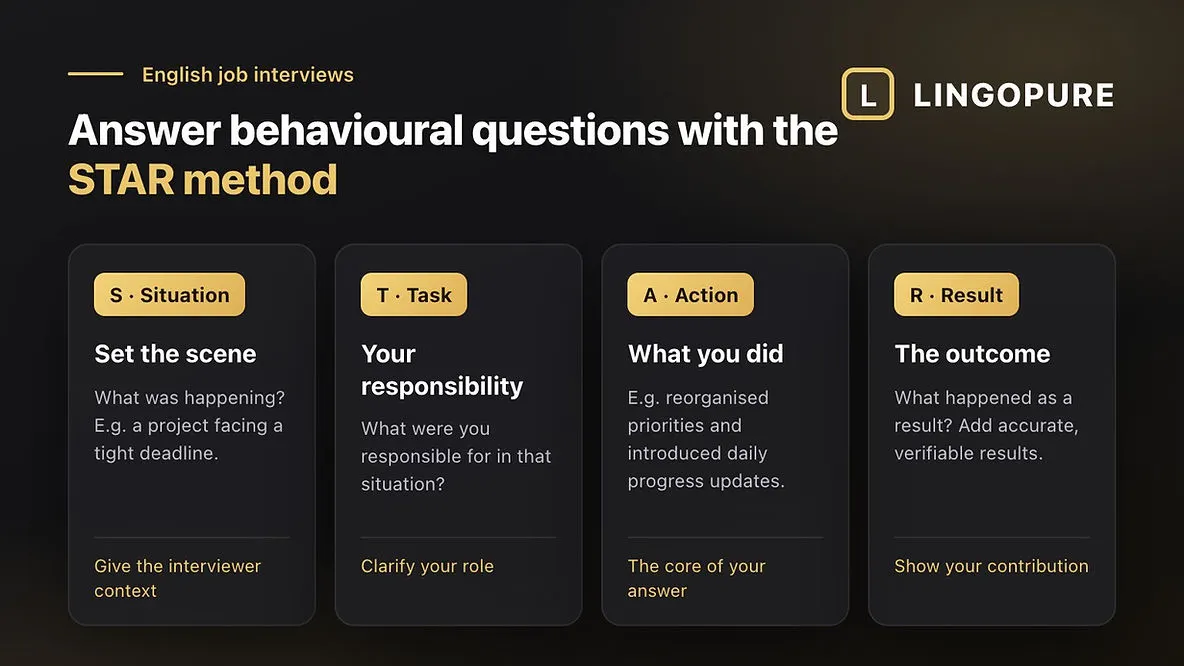
A useful framework is STAR:
- Situation: What was happening?
- Task: What were you responsible for?
- Action: What did you do?
- Result: What happened as a result?
Sample answer:
"Our team was facing a tight project deadline. I was responsible for coordinating the delivery process. I reorganised our priorities and introduced daily progress updates. As a result, we completed the project on time."
Use your own experience rather than presenting a sample scenario as something you actually did. Where relevant, include accurate and verifiable results.
6. How do you handle pressure?
A strong answer explains your working process rather than simply claiming that you perform well under pressure.
Sample answer:
"When I'm under pressure, I break large tasks into smaller steps, prioritise urgent work and communicate early if I see any risks to the deadline."
This demonstrates organisation, communication and accountability.
7. How do you work with international teams?
This question is particularly relevant to remote jobs and positions involving colleagues from different cultures or time zones.
Sample answer:
"I believe clear communication is essential when working across cultures and time zones. I make sure expectations are aligned, document important decisions and provide regular updates."
If you have not worked internationally before, be transparent. You can explain how your existing collaboration experience would transfer to a global environment.
8. Why are you leaving your current job?
Keep your answer professional and focused on your future.
Sample answer:
"I'm grateful for what I've learned in my current position, but I'm looking for a role with greater opportunities to work on international projects and take on new responsibilities."
You can be truthful about your reasons without making negative comments about previous colleagues or employers.
9. What are your salary expectations?
Prepare for this question before the interview by researching compensation ranges for comparable roles.
Sample answer:
"Based on the responsibilities of this role and my experience, I'm looking for a salary in the range of [amount]. However, I'm open to discussing the overall compensation package."
Your proposed range should reflect your circumstances, the market and the responsibilities involved.
10. Do you have any questions for us?
Rather than ending with "No", use this opportunity to understand the role more deeply.
Consider asking:
- "What would success look like in the first three months?"
- "How does the team usually collaborate?"
- "What are the biggest challenges someone in this role would face?"
Good questions demonstrate curiosity and help you evaluate whether the opportunity is right for you.
Three common mistakes in English job interviews
Memorising complete scripts: A change in wording can make you lose your place. Practise answering the same question in different ways instead.
Using unnecessarily complicated vocabulary: Clear, precise language is usually more effective than impressive words used incorrectly.
Describing responsibilities without outcomes: Employers want to understand not only what you were assigned to do but also what you contributed and what happened next.
How to practise before your interview
Start with five questions most relevant to the position you want. Write brief notes, record yourself answering each question and listen back.
Ask yourself:
- Did I answer the question directly?
- Did I provide a specific, truthful example?
- Was my main point easy to follow?
- Did I speak too quickly or hesitate during important parts?
Repeat the exercise without reading from your notes. This helps you build flexibility rather than dependence on a prepared script.
Frequently asked questions
Can I apply for international jobs if my English is not fluent?
Yes, depending on the role and employer. Some positions require frequent client-facing communication, while others rely more heavily on written updates or technical documentation. Review the job requirements and focus your practice on the communication tasks that matter most.
Should I memorise English interview answers?
It is better to learn useful structures and expressions than to memorise every sentence. You should be able to adjust your answer to the question and communicate your actual experience naturally.
Make your experience come through in English
A successful English job interview is not about using the most sophisticated vocabulary. It is about explaining your experience clearly, supporting your claims with relevant examples and communicating professionally.
LingoPure's English for Job Hunting programme focuses on real interview situations, including introductions, challenging questions and salary conversations.
Build the English you need at work
Start with a free assessment and identify the communication situations that deserve focused practice.
Sign up