Lingopure blog
5 Signs Your Company Needs an Employee English Skills Assessment
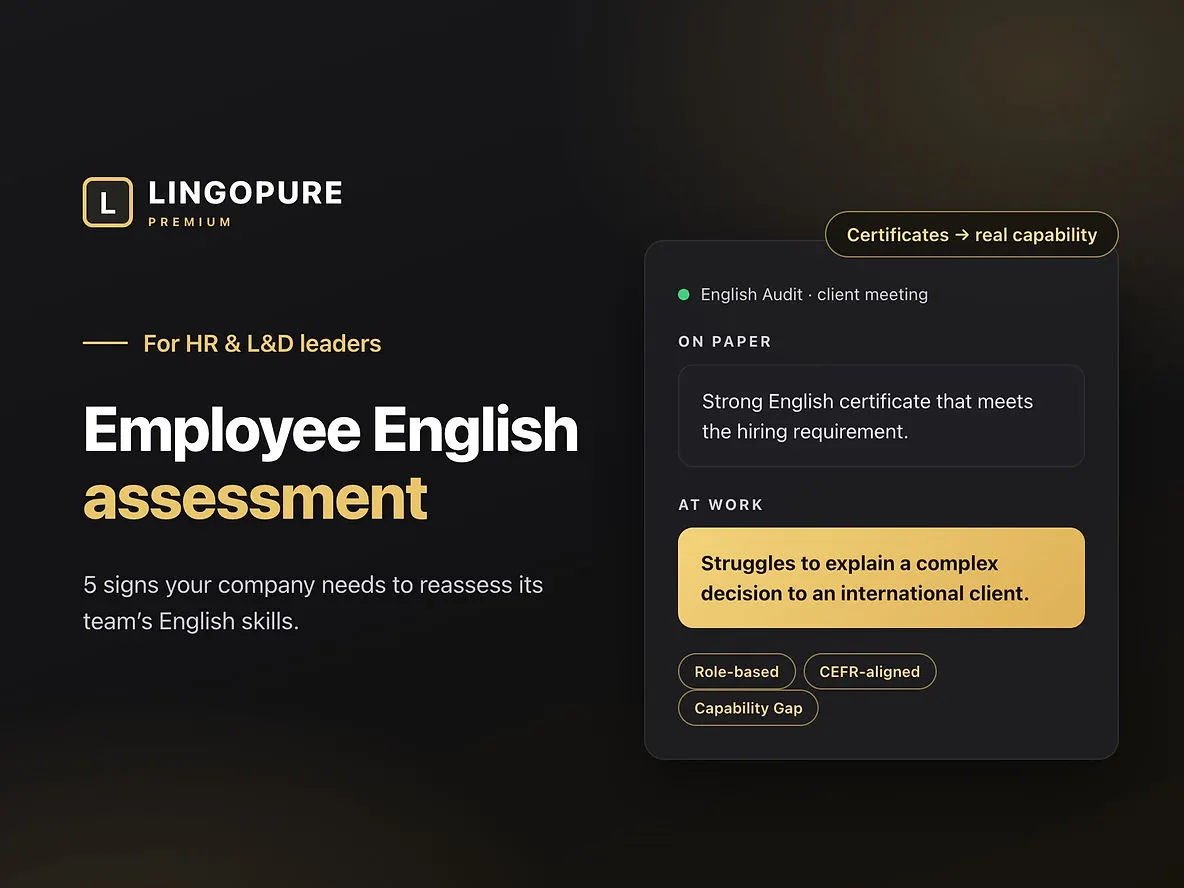
An employee may hold a strong English qualification and still struggle to explain an important decision to an international client.
A team may complete an English training programme, yet management may still have little evidence of how workplace communication has improved.
This highlights an important distinction: knowing someone's general English level is not the same as understanding how effectively they use English at work.
For HR managers, L&D leaders and department heads, a structured employee English skills assessment can help identify where communication gaps exist and what training should prioritise.
Here are five signs that your organisation may need to reassess its team's English capabilities.
1. Employees have English certificates but struggle in real conversations
Qualifications provide useful information about language proficiency. However, they may not reveal every challenge an employee encounters in a specific workplace situation.
Consider these examples:
- An employee understands a meeting but rarely contributes to the discussion.
- A project manager has strong technical expertise but struggles to explain a complex decision.
- A customer service representative knows the process but finds it difficult to respond when a conversation moves beyond the script.
A grammar or reading assessment alone may not fully capture these communication demands.
What should employers do?
Assess employees through realistic workplace tasks, such as explaining a problem, presenting information, answering questions or handling a customer scenario.
The goal is to understand what an employee can do with English, not simply what they know about the language.
2. International clients frequently ask for clarification
When client conversations take longer than expected because messages are unclear, the problem may not be technical expertise.
An employee might understand the issue perfectly but find it difficult to:
- Organise information logically.
- Explain technical terms in accessible language.
- Confirm client expectations.
- Summarise decisions and next steps.
These skills are particularly relevant in IT outsourcing, BPO, financial services and other client-facing environments.
What should employers do?
Review where misunderstandings occur during communication.
Determine whether the issue is related to language, internal processes or unclear responsibilities.
Not every communication problem can be solved by English training alone. Identifying the underlying cause is essential.
3. The company invests in training but cannot demonstrate progress
Many training programmes measure attendance, lesson completion and learner satisfaction.
These metrics provide useful operational information, but they do not necessarily show whether an employee communicates more effectively at work.
HR and L&D teams should consider two categories of evidence.
Language capability indicators:
- Listening comprehension and spoken responses.
- Clarity of expression.
- Interaction and presentation skills.
- Progress measured against a consistent framework such as CEFR.
Workplace application indicators:
- Confidence and participation during meetings.
- Ability to explain issues independently to clients.
- Clarity of emails and written reports.
- Performance in specific job-related communication tasks.
Workplace indicators should be observed across comparable situations rather than judged from a single incident.
Combining these perspectives can help organisations make better-informed decisions about their training priorities.
4. Different departments need English for different purposes
A sales executive, software engineer and HR manager may all use English every day, but their communication requirements are not identical.
For example:
| Department | Typical English communication needs |
|---|---|
| Sales | Discovery calls, objection handling, negotiation |
| IT | Daily stand-ups, technical reviews, stakeholder updates |
| Customer Service | Complaint handling, issue clarification |
| HR | Interviews, performance reviews, policy discussions |
| Management | Presentations, reporting, meeting facilitation |
A general English course may offer a useful foundation, but it may not address the most important communication requirements for every role.
What should employers do?
Identify critical communication tasks by department before deciding on the training curriculum.
Role-based assessment helps organisations understand which skills should be prioritised rather than relying exclusively on general proficiency levels.
5. HR lacks clear evidence to justify the training budget
One of the most difficult questions for an HR or L&D leader is:
"Why should we invest more in English training?"
General observations such as "the team needs better English" are rarely sufficient to define the scope of an effective programme.
A structured assessment should help answer several questions:
- What communication tasks can employees currently perform?
- Where do they struggle?
- Which skill gaps are most relevant to their roles?
- Which groups should receive priority?
- How will progress be measured?
With a documented starting point, organisations can define more specific objectives and evaluate whether future training addresses the original problems.
A four-step framework for assessing workplace English
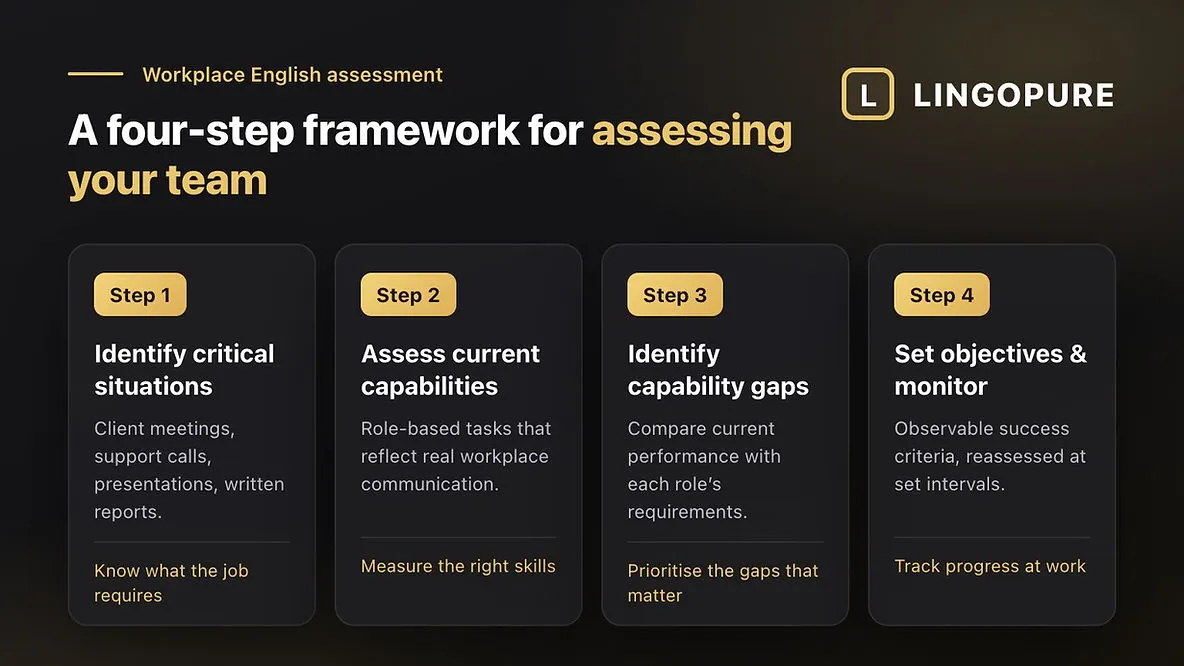
Step 1: Identify critical communication situations
List the English-language tasks employees perform regularly.
These might include client meetings, customer support interactions, technical presentations or written reporting.
Step 2: Assess current capabilities
Evaluate how employees understand, respond and communicate in situations related to their responsibilities.
Choose assessment methods that reflect the skills being evaluated.
Step 3: Identify capability gaps
Compare current performance with what each role requires.
Not every employee needs the same English level. The key is identifying the gaps that matter most to the business.
Step 4: Set objectives and monitor progress
Define the priority skills, establish observable success criteria and reassess performance at appropriate intervals.
The purpose is not simply to improve test scores. It is to help employees communicate more effectively in the work they actually do.
What role does CEFR play in corporate English assessment?
The Common European Framework of Reference for Languages (CEFR) describes language proficiency across six main levels, from A1 to C2.
It provides a shared reference for discussing language capability.
For organisations, this can make it easier to document starting levels and monitor development using consistent criteria.
However, a CEFR level alone does not guarantee that an employee can successfully complete every communication task required by a particular role.
That is why proficiency assessment is most useful when combined with role-specific workplace scenarios.
Frequently asked questions
How often should companies reassess employee English skills?
The frequency depends on the organisation's objectives and training duration. A practical approach is to assess employees before training, monitor progress during the programme and conduct follow-up assessments at meaningful intervals.
Do small businesses need employee English assessments?
They may, especially when a few roles involve regular communication with international clients or partners.
A smaller organisation does not necessarily need to assess every employee immediately. It can begin with business-critical positions and expand based on the findings.
Start with a Free English Audit from LingoPure
Before approving another training budget, organisations should understand their teams' current communication capabilities.
LingoPure offers a Free English Audit designed to help HR and L&D teams identify workplace English skill gaps.
The assessment includes:
- Free assessment for up to three employees.
- A 45–60-minute live assessment per person.
- Communication scenarios adapted to each participant's role.
- A written Capability Gap Report, including CEFR-aligned findings and recommended next steps.
- Reports provided within three business days, with no obligation to enrol in a training programme.
Instead of beginning with a predetermined course, start by identifying which communication challenges need to be addressed.
Build the English you need at work
Start with a free assessment and identify the communication situations that deserve focused practice.
Sign up