Lingopure blog
Learning English with AI Every Day: Are You Actually Improving or Just Getting Better at Talking to Chatbots?
You can speak English with an AI chatbot for 30 minutes without feeling particularly nervous. But could you handle a challenging job interview, a spontaneous conversation, or a meeting with an international client just as confidently?
That question is becoming increasingly relevant as artificial intelligence changes the way people learn languages.
AI tools can simulate interviews, correct grammar, suggest vocabulary, and provide conversation practice whenever you need it. For busy adults, that level of accessibility is genuinely valuable.
But there is an important distinction between performing well in an AI conversation and communicating effectively in real life.
So, does learning English with AI really work? And can AI replace English teachers?
The research offers a more interesting answer than a simple yes or no.
1. Yes, AI can help improve your English speaking skills
One of AI's biggest advantages is the opportunity to practise without waiting for a scheduled lesson.
You can rehearse a presentation, simulate a job interview, or practise ordering food while travelling. You can repeat the same conversation several times without worrying about making mistakes in front of another person.
For learners who feel anxious about speaking English, that lower-pressure environment can be particularly helpful.
And research supports some of these benefits.
A systematic review published in Telematics and Informatics Reports in September 2026 examined ten empirical studies on conversational chatbots and English speaking proficiency.
The review found the strongest improvements in intelligibility and vocabulary range, alongside moderate improvements in fluency and accuracy, particularly among beginner and intermediate learners.
Learners also frequently reported increased motivation, greater willingness to communicate, and reduced speaking anxiety.
These findings suggest that AI is more than a passing trend in language learning.
It can provide meaningful speaking practice, especially for learners who lack regular opportunities to use English.
However, improved chatbot performance does not tell us everything about real-world communication.
2. Speaking English is not the same as handling a conversation
Imagine practising this sentence with an AI chatbot:
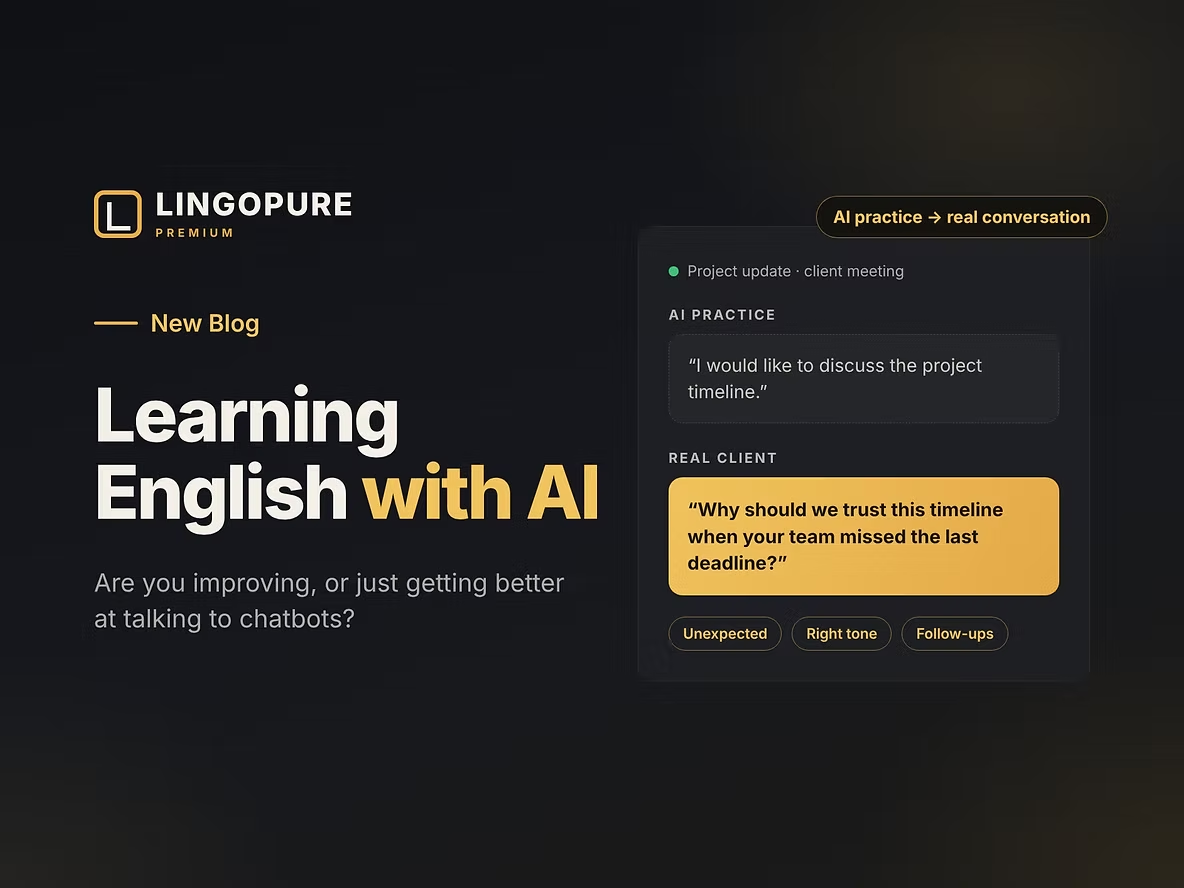
“I would like to discuss the project timeline.”
The chatbot understands you, responds politely, and allows the conversation to continue.
Now imagine presenting the same project to a client who asks:
“Why should we trust this timeline when your team missed the last deadline?”
Suddenly, the challenge is no longer just finding grammatically correct words.
You need to recognise the concern behind the question, respond professionally, explain your reasoning, and possibly handle several unexpected follow-up questions.
Real conversations involve interruptions, misunderstandings, changing emotions, different accents, and social expectations.
They require more than vocabulary and sentence structure.
This is where the current evidence becomes especially interesting.
The September 2026 systematic review found that while chatbot-based practice showed encouraging results for certain speaking skills, interaction and coherence were rarely assessed in the included studies.
In other words, we have promising evidence that AI can help people practise speaking. We have less evidence about whether those improvements consistently transfer to complex, spontaneous interactions with real people.
That does not make AI ineffective.
It means we should be careful about how we define progress.
3. AI can correct your grammar. Can it always understand the situation?
Consider two ways of disagreeing with a colleague:
“You are wrong.”
And:
“I see your point, but I think we should consider another approach.”
Both sentences are grammatically acceptable.
But they communicate very different levels of diplomacy.
Choosing the right expression depends on the relationship between speakers, the purpose of the discussion, and the cultural context.
AI can often suggest more suitable phrasing. Yet its feedback is not always equally reliable across accents, contexts, or complex social situations.
A 2026 systematic review in Discover Education identified persistent limitations in pragmatic competence, discourse management, and cultural nuance in AI-assisted language learning.
This matters because successful communication is not simply about producing correct sentences.
It is about knowing what to say, how to say it, and when a different approach might work better.
Learners should therefore treat AI feedback as useful guidance rather than an unquestionable authority.
4. Can AI replace an English teacher? The debate is more complicated than it seems
There are reasonable arguments on both sides.
The case for AI
AI makes language practice more accessible and flexible.
Learners can practise at their own pace, repeat difficult situations, and receive immediate feedback. It may also provide a starting point for people who cannot attend regular lessons.
For certain tasks, AI can be a highly practical learning companion.
The case for human teachers
Effective teaching involves more than correcting mistakes.
A teacher can observe how a learner responds under pressure, adapt activities to their needs, challenge them with unexpected questions, and provide feedback on communication in context.
A teacher can also help connect language development to a specific goal, such as preparing for interviews, participating in meetings, or building confidence in everyday conversations.
In its 2025 paper Human-centred AI: Lessons for English Learning and Assessment, the British Council advocated an approach that keeps learner needs and educational expertise at the centre of AI adoption.
The more useful question may therefore be:
Which parts of English learning can AI support effectively, and where does human interaction add something different?
For many learners, the strongest approach will not involve choosing one and rejecting the other.
It will involve using each for the tasks it does best.
5. How to combine AI practice with real English conversations
Instead of simply chatting with AI for as long as possible, give each practice session a specific objective.
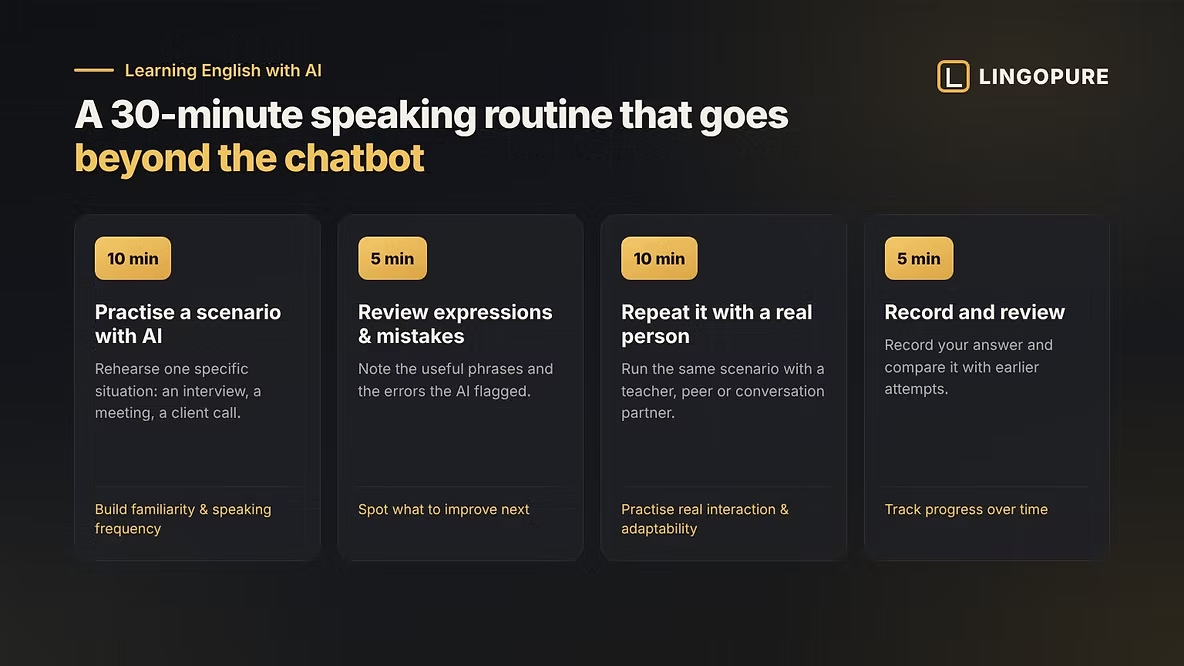
Here is an example of a 30-minute speaking routine:
| Time | Activity | Purpose |
|---|---|---|
| 10 minutes | Practise a specific scenario with AI | Build familiarity and speaking frequency |
| 5 minutes | Review useful expressions and mistakes | Identify opportunities to improve |
| 10 minutes | Repeat the scenario with a teacher, peer, or conversation partner | Practise real interaction and adaptability |
| 5 minutes | Record and review your response | Track progress over time |
This is a suggested routine, not a guaranteed formula.
The important principle is to move from controlled practice towards communication that is less predictable.
An AI prompt worth trying
“Act as an interviewer at an international company. Ask me one question at a time. Do not suggest answers before I respond. After each answer, give brief feedback on clarity, vocabulary, and natural phrasing. Ask unexpected follow-up questions when appropriate.”
A prompt like this can make your practice more challenging and purposeful.
It also encourages you to produce your own responses rather than simply repeat model answers.
6. How can you tell whether your English is actually improving?
Many language-learning tools measure activity through streaks, completed lessons, or minutes practised.
These metrics can help establish a habit.
But they do not necessarily show how well you communicate.
Consider tracking progress through questions such as:
- Can you answer an unexpected question without preparing every sentence?
- Can you ask for clarification when you misunderstand someone?
- Can you explain a complicated idea using simple, understandable English?
- Can you adjust your tone for a colleague, client, or interviewer?
- Can you handle the same speaking scenario more clearly and confidently after several weeks?
One useful approach is to record yourself responding to the same speaking task at different points in your learning journey.
You can then compare clarity, fluency, vocabulary, and your ability to develop an answer.
Feedback from a qualified teacher or another experienced speaker can add valuable context to that self-assessment.
The goal is not merely to sound more fluent while talking to a chatbot.
It is to become better prepared for conversations that matter.
7. The future of English learning is not necessarily AI versus teachers
AI is changing access to English practice.
It makes repetition easier, removes some scheduling barriers, and creates opportunities for learners who previously had few people to practise with.
That progress should be welcomed.
At the same time, language learning remains fundamentally connected to human communication.
We learn English to exchange ideas, build relationships, solve problems, and participate in situations where the other person may respond in ways we cannot predict.
Technology can support that development.
But the real measure of progress is not how long you can keep an AI conversation going.
It is what you can communicate when the chatbot is no longer there.
Build English communication skills for real situations with LingoPure
At LingoPure, we focus on helping learners develop practical English communication skills through teacher-led learning experiences and activities connected to real communication goals.
Whether you are preparing for an interview, looking to contribute more confidently at work, or simply want to express yourself more naturally, the right practice should help you move beyond memorised answers.
Explore English learning with LingoPure
Frequently Asked Questions
Does learning English with AI really work?
Research suggests that AI-supported learning can help with speaking practice, vocabulary development, confidence, and certain aspects of fluency. Results vary across learners and tools, and improvement in chatbot conversations does not automatically demonstrate improvement in every real-world speaking skill.
Can ChatGPT help me practise spoken English?
Yes. Voice-based AI conversations can be used for role-play, interview practice, and language feedback. For more balanced development, combine these activities with real conversations and feedback from a teacher or experienced speaker.
Can AI replace an English teacher?
AI can support several teaching and practice tasks, but current evidence does not establish that it can fully replace all aspects of human instruction, particularly contextual communication, personalised teaching, and complex interaction.
Is 15 minutes of AI English practice every day enough?
A short, consistent session can be a useful starting point. However, there is no universal duration that guarantees progress. The quality of practice, your goals, your current level, and opportunities for real interaction all matter.
What is the best way to use AI to improve English speaking?
Choose a specific communication scenario, practise responding without reading a script, request focused feedback, and apply what you learn in conversations with real people.
References
- Soriano-Gonzalez, L. & Belda-Medina, J. (2026). Chatbots for oral proficiency in English language learning: A systematic review. Telematics and Informatics Reports. https://doi.org/10.1016/j.teler.2026.100346
- A PRISMA-based systematic review of artificial intelligence in English as a foreign and second language education (2023–2025). Discover Education (2026). https://doi.org/10.1007/s44217-026-01504-y
- British Council (2025). Human-centred AI: Lessons for English Learning and Assessment. https://www.britishcouncil.org/research-insight/human-centred-ai-lessons-english-learning-assessment
Build the English you need at work
Start with a free assessment and identify the communication situations that deserve focused practice.
Book a free demo