Lingopure blog
English Communication for BPO: 5 Costly Gaps in the AI Era, from LingoPure
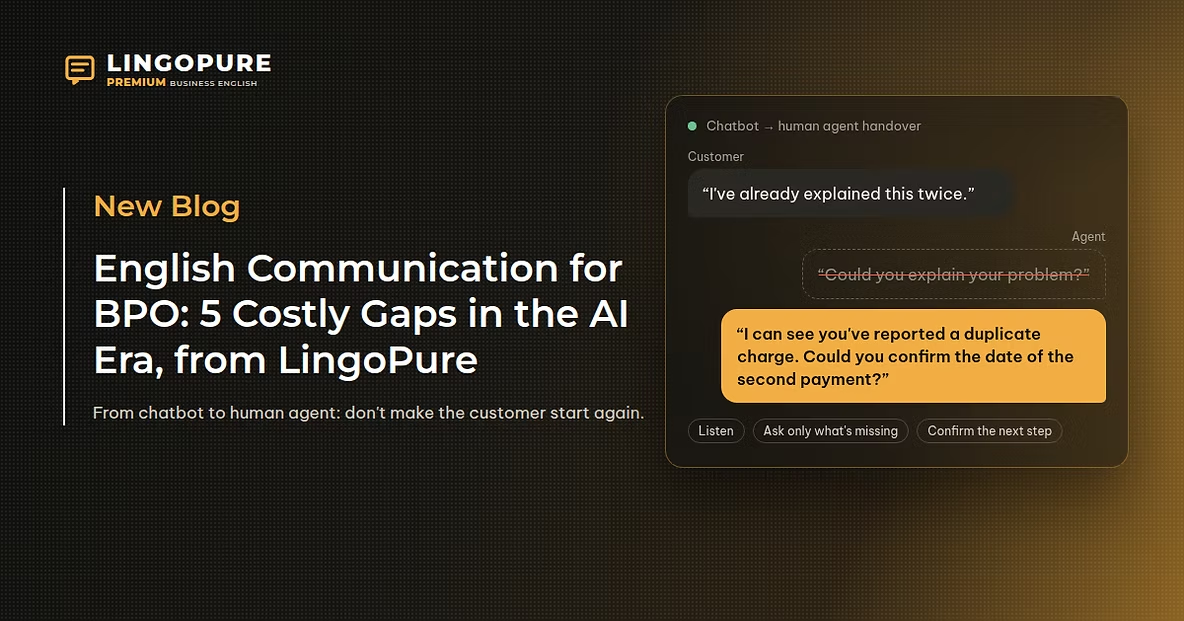
English communication for BPO involves more than fluent speech and accurate grammar. An effective customer interaction should leave the customer understanding the issue, the available solution and what happens next.
Imagine a customer explaining a billing problem to a chatbot. They reach a human agent and hear:
"Could you explain your problem?"
The English is correct. The experience may still feel frustrating.
According to Zendesk's CX Trends 2026 report, 74% of surveyed consumers feel frustrated when they have to repeat information. This is a finding about customer experience broadly, not a measure of English-related problems in BPO operations. It nevertheless raises a useful question: can your agents continue a conversation without making the customer start again?
Why English communication for BPO still matters with AI
AI can assist with drafting responses and summarising earlier interactions. When an agent takes over, however, they still need to check the information, ask relevant questions and explain what the business can actually do.
A detailed summary does not guarantee a clear explanation. A grammatically correct response does not necessarily tell the customer who owns the next step.
For business process outsourcing teams, unclear communication can create additional work: another explanation, another contact or a supervisor's intervention to clarify a commitment. Training therefore needs to address how agents use English in specific service situations.
Five gaps in English communication for BPO teams
1. Asking customers to repeat information already available
Starting from the beginning can suggest that earlier conversations have been ignored.
✗ Instead of: "Please explain everything again."
✓ Try: "I can see you've already reported a duplicate charge. Could you confirm the date of the second payment?"
The agent demonstrates awareness and asks only for the missing detail.
Practice activity Give agents a short conversation history. Ask them to summarise the issue and identify one necessary clarification. If the history is unavailable, practise explaining that limitation honestly.
2. Giving vague timelines
"We'll update you soon" leaves the customer guessing.
✓ When an update deadline is confirmed: "Our billing team will email you by Friday with an update."
✓ When no resolution time is available: "I don't have a confirmed resolution time yet. I'll check with the billing team and confirm the next update."
An update deadline and a resolution deadline are different commitments. Agents should never invent a refund date or approval timeline to make a conversation easier.
Practice activity Use scenarios with and without approved timelines. Assess whether agents communicate the difference accurately.
3. Using internal jargon
Customers need to understand their situation without learning the company's internal terminology.
✗ Instead of: "Your case is pending internal validation."
✓ Try: "Our team is checking the payment details before deciding whether a refund can be approved."
Start with the information the customer needs. Add relevant context, then explain the next action.
Practice activity Rewrite five jargon-heavy responses in everyday English while preserving the original meaning and policy requirements.
4. Creating incomplete escalation handovers
A note saying "Customer unhappy. Please assist" gives the next agent little useful context. A practical handover should include:
- The issue the customer reported.
- The actions already taken.
- The current status.
- The team that needs to take over.
- The next action and any commitments already made.
✓ For example: "The customer reports two charges for one order. We checked the order record, but the second charge remains unverified. Billing review is needed. No refund has been promised."
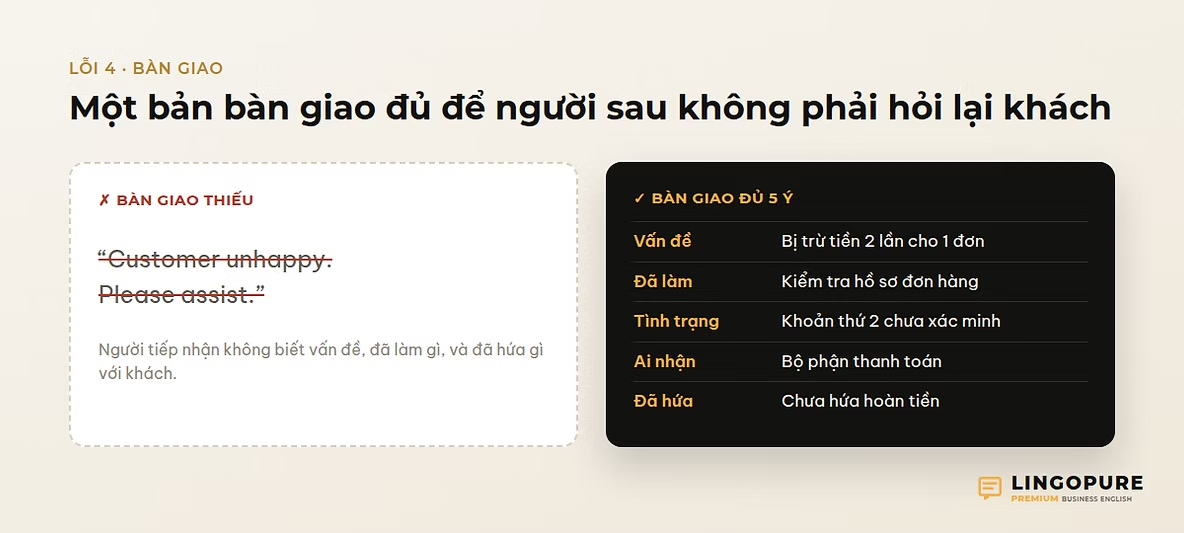
Practice activity Ask a second agent to continue the case using only the first agent's handover. Identify what information is missing.
5. Ending without confirming ownership
"Is there anything else?" cannot replace a clear summary. Before ending, confirm the action and its owner:
"To confirm, I'll submit the billing review request today. You don't need to send the documents again."
Add the next update channel or deadline when it has been confirmed.
Practice activity Reserve the final 20–30 seconds of each role-play for actions, ownership and anything the customer needs to do.
These examples are training prompts. Agents should adapt them to the actual case, their authority and approved company policies.
Quick reference: 5 gaps and how to fix them
| Gap | Avoid | Use instead |
|---|---|---|
| Repeat request | "Please explain everything again." | "I can see you've already reported… Could you confirm…?" |
| Vague timeline | "We'll update you soon." | "Our billing team will email you by Friday." |
| Internal jargon | "Pending internal validation." | "We're checking the payment details first." |
| Incomplete handover | "Customer unhappy. Please assist." | Issue · actions taken · status · owner · commitments |
| Unclear close | "Is there anything else?" | "To confirm, I'll submit the review today." |
What can communication-related rework cost?
Start with a simple internal calculation: repeat contacts that QA identifies as communication-related × average handling time per additional contact.
For an illustrative example, suppose QA identifies 150 repeat contacts in one month linked to unclear instructions. Each takes six additional minutes. 150 × 6 minutes = 900 minutes, or 15 staff hours.
This is a hypothetical calculation, not an industry benchmark or a LingoPure result. Teams should distinguish communication problems from system failures, processing delays and unclear policies before estimating the impact.
How to assess English communication for BPO
CEFR describes language proficiency, including aspects of interaction and mediation. It does not replace an operation-specific service quality framework. See how LingoPure runs a CEFR-based assessment.
An agent may communicate fluently but misunderstand escalation rules. Another may understand the process but struggle to explain it under pressure. Assess both language ability and observable service behaviours:
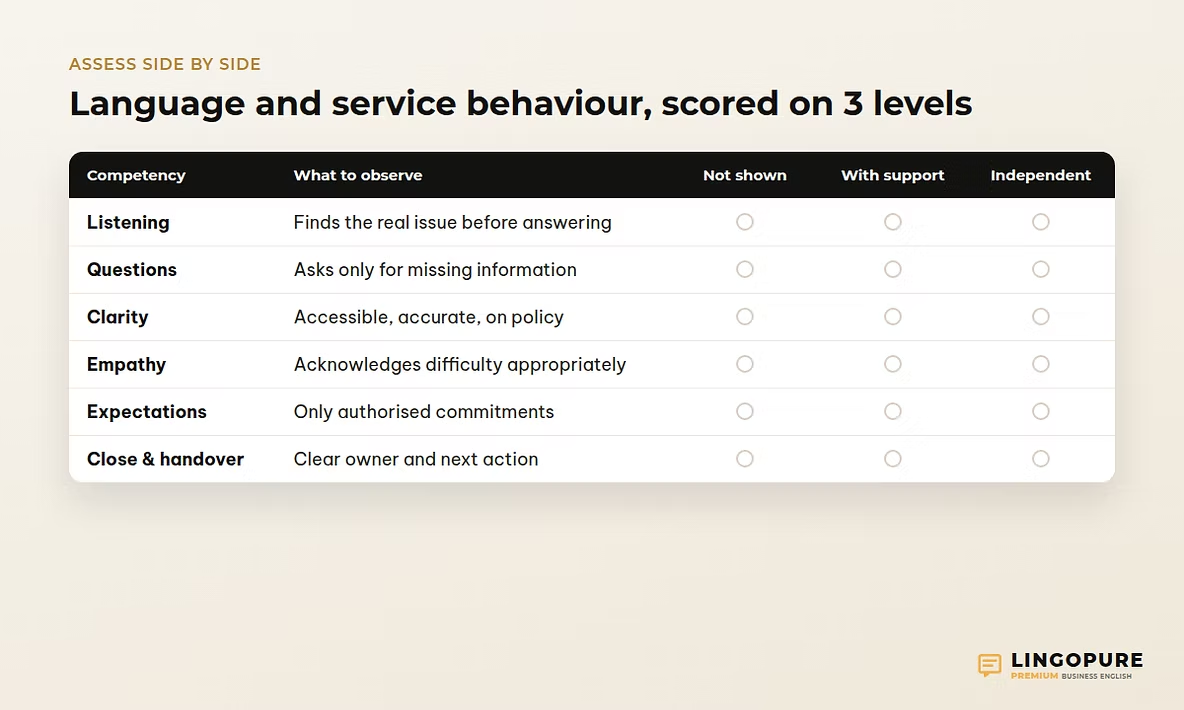
| Competency | What to observe |
|---|---|
| Listening | Identifies the actual issue before responding |
| Question quality | Requests relevant missing information |
| Clarity | Explains accurately in accessible language |
| Empathy | Acknowledges the customer's difficulty appropriately |
| Expectation-setting | Makes only authorised commitments |
| Closing and handover | Confirms ownership and next actions |
A simple rubric can use three levels: not demonstrated, demonstrated with support, demonstrated independently. Assessors should record specific examples and review sample interactions together so that the scoring remains consistent.
Turn assessment findings into targeted training
Choose three scenarios relevant to your operation, such as delayed deliveries, billing disputes and complaint escalations. After the baseline assessment:
- Prioritise one or two gaps. Focus on behaviours that most clearly disrupt the interaction.
- Group agents by need. Agents struggling with explanations need different practice from those struggling with handovers.
- Give specific feedback. Identify the wording that caused confusion and practise an alternative.
- Reassess with equivalent scenarios. Change the details while keeping the difficulty comparable to test application rather than script memorisation.
Remove customer-identifying information from training materials and follow your organisation's data-handling requirements. Track communication progress alongside repeat contacts, QA results and customer satisfaction. A shorter call alone does not establish that service has improved.
Frequently asked questions
Do fluent English speakers still need BPO communication training?
They may. Fluency alone does not demonstrate effective questioning, expectation-setting or handovers. Use role-plays and QA observations to identify whether additional training is needed.
Should training aim for a native accent?
Prioritise intelligibility, appropriate pace and accurate meaning. The goal is to help customers understand and act on the information provided.
How often should agents be reassessed?
Choose a cadence that fits the learning cycle and coaching capacity. Use consistent criteria and scenarios of comparable difficulty so that results are meaningful.
How LingoPure can support your team
LingoPure provides work-related English training built around practical communication needs, with CEFR-based progress reporting. For BPO leaders, a useful starting point is a specific question: where does communication break down between understanding the customer's issue and confirming the next action? Explore English training for BPO teams.
Build the English you need at work
Start with a free assessment and identify the communication situations that deserve focused practice.
Book a free demo