Lingopure blog
Business English in the AI Era: Why Communication Skills Still Matter in 2026
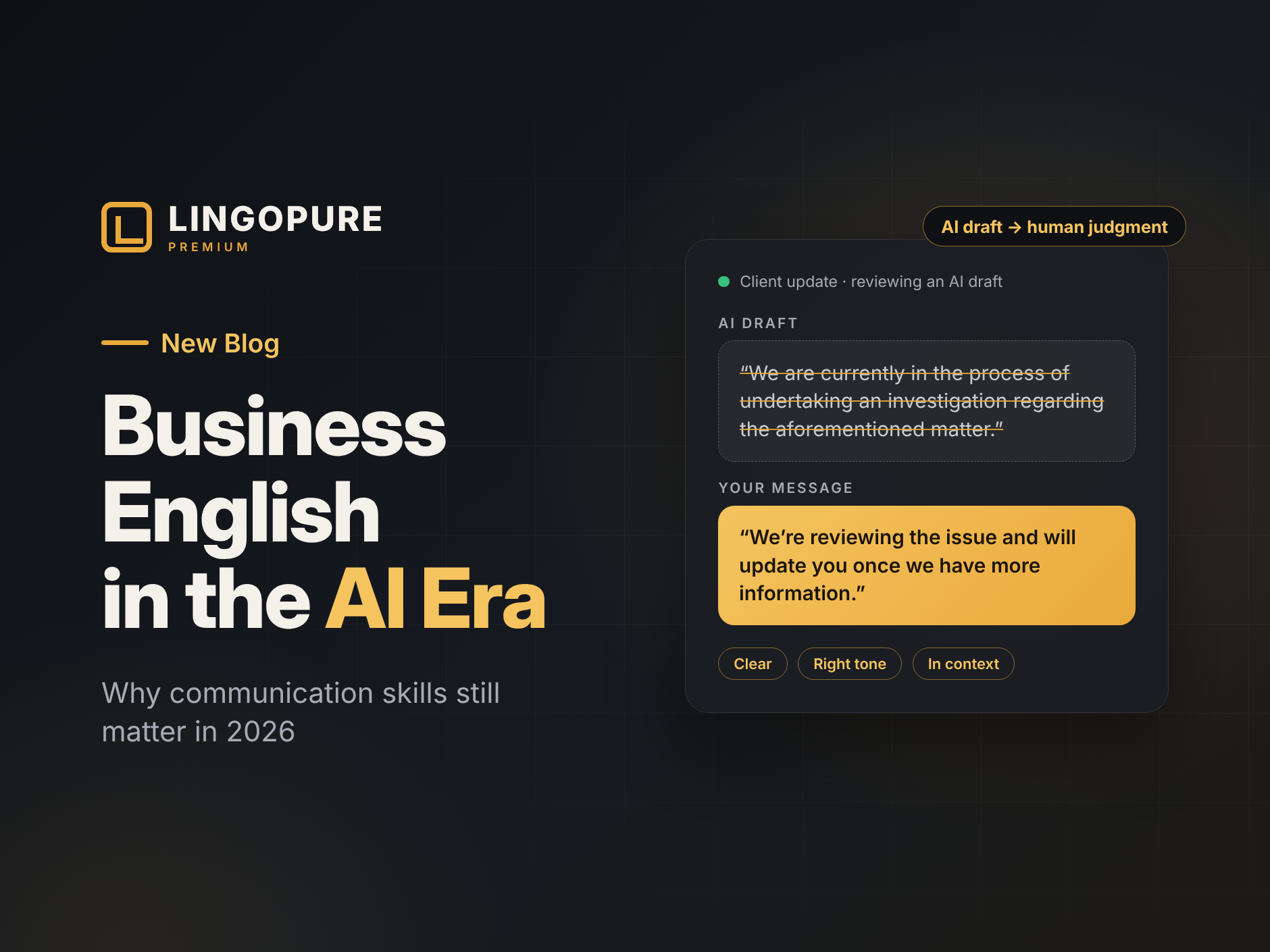
AI is transforming the workplace, but one essential skill remains difficult to automate: meaningful human communication.
As artificial intelligence becomes part of everyday business operations, professionals are learning to work alongside increasingly capable digital tools. AI can draft emails, summarise meetings, translate documents and support customer interactions within seconds.
But does that mean learning business English is becoming less important?
Not quite.
New research into the future of work suggests that technological expertise and human communication skills are becoming increasingly interconnected. For professionals working with international clients and teams, business English remains an important tool for building trust, explaining complex ideas and making decisions.
AI Is Changing the Skills Employers Need in 2026
The workplace is undergoing a significant transformation.
According to the World Economic Forum's Future of Jobs Report 2025, employers expect 39% of workers' existing skill sets to change by 2030.
The report also identifies analytical thinking, resilience, leadership, creative thinking and technological literacy among the core capabilities employers value.
More recently, an August 2026 report from the International Labour Organization examined how AI adoption is reshaping workplace skills. Its findings highlight the growing importance of cognitive, socioemotional and digital capabilities.
The message for businesses is clear: preparing employees for an AI-enabled workplace involves more than teaching them to use new technology.
It also means developing the human skills needed to apply that technology effectively.
For international organisations, communication in English can be an important part of that preparation.
Why Business English Still Matters When AI Can Translate
AI-powered translation and writing tools have made multilingual communication more accessible.
Employees can now translate a message, generate a professional email or prepare a presentation with significantly less manual effort.
However, successful workplace communication involves more than producing grammatically correct sentences.
Consider a customer service representative handling a frustrated international customer.
An AI tool may suggest an accurate response, but the employee still needs to understand the customer's concerns, recognise the emotional context and decide how to communicate the next steps.
Similarly, a manager negotiating with an overseas partner must consider tone, cultural expectations, timing and relationship-building.
These situations require judgment, not simply translation.
Business English is not just about knowing what to say. It is about understanding how, when and why to say it.
1. Building Trust With International Clients
Clear communication helps professionals explain expectations, acknowledge concerns and avoid unnecessary confusion.
In client-facing roles, the ability to communicate naturally and professionally can support stronger working relationships.
2. Participating Confidently in Global Meetings
AI can generate meeting notes, but employees still need to ask relevant questions, explain their viewpoints and respond to unexpected discussions.
Business English skills help professionals participate rather than simply observe.
3. Managing Sensitive Conversations
Difficult feedback, service complaints and negotiations often require careful wording.
The right message delivered in the wrong tone can still create misunderstanding.
Professionals who understand tone and context are better prepared to handle these conversations.
Five Business English Skills Professionals Should Develop in 2026
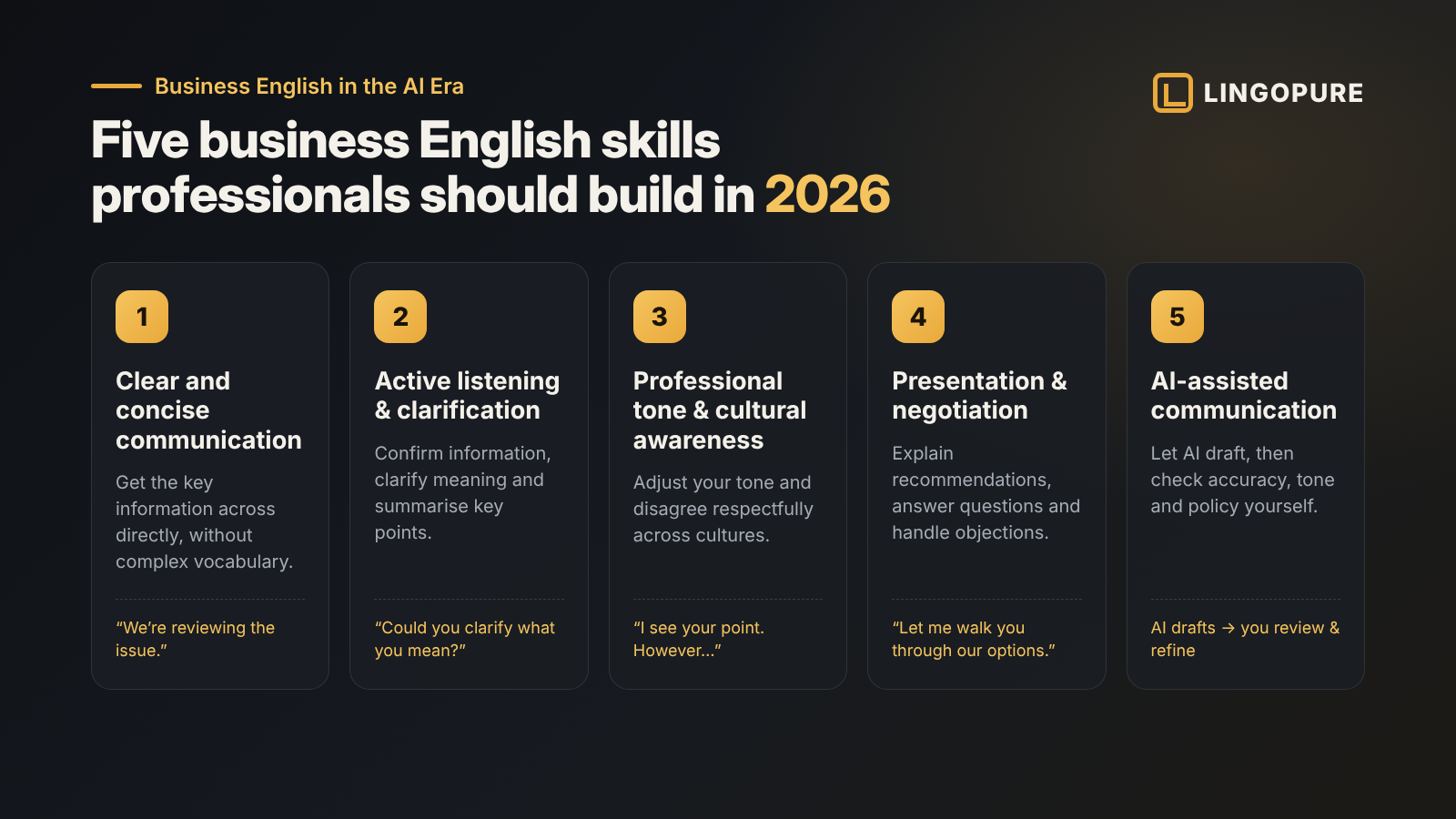
As AI becomes more integrated into business operations, professionals can benefit from focusing on practical communication capabilities.
1. Clear and Concise Communication
International teams need messages that are easy to understand.
Instead of relying on complex vocabulary, employees should learn to communicate essential information directly.
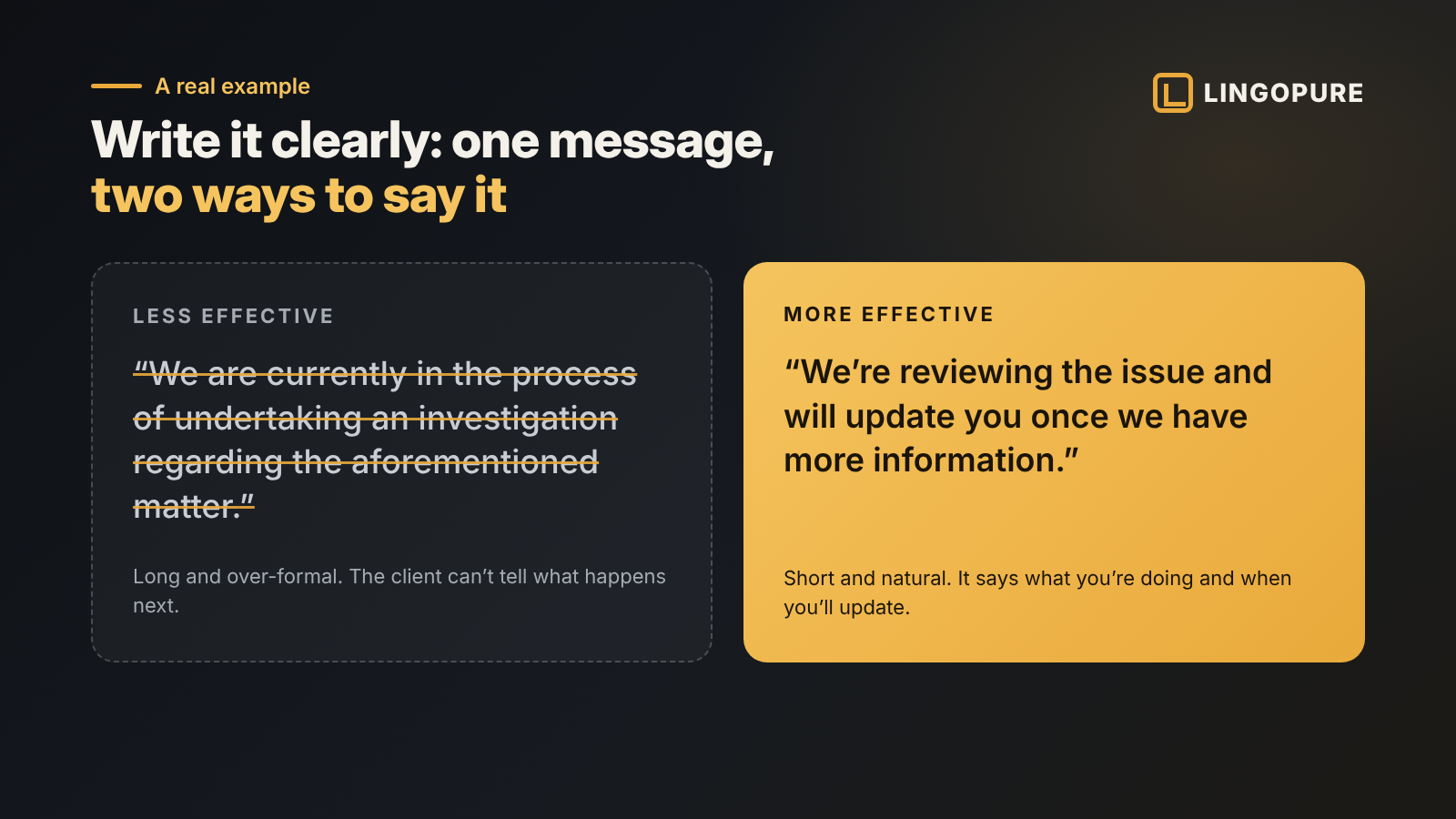
For example:
Less effective: "We are currently in the process of undertaking an investigation regarding the aforementioned matter."
More effective: "We're reviewing the issue and will update you once we have more information."
The second version communicates the same message more naturally.
2. Active Listening and Clarification
Understanding a conversation is just as important as speaking.
Professionals should feel comfortable asking for clarification, confirming information and summarising key points.
Useful expressions include:
- "Could you clarify what you mean by that?"
- "Just to confirm, our next step is..."
- "Let me make sure I've understood correctly."
These skills are especially valuable in customer support, project management and cross-functional collaboration.
3. Professional Tone and Cultural Awareness
English is used across different countries, industries and professional environments.
A communication style that works well in one context may be less effective in another.
Learning to adjust tone, express disagreement respectfully and communicate expectations clearly can help professionals collaborate across cultures.
4. Presentation and Negotiation Skills
AI can help structure a presentation or prepare talking points.
However, professionals must still explain their recommendations, answer questions and respond to objections.
Practising realistic workplace situations can help employees become more confident when presenting ideas or participating in negotiations.
5. AI-Assisted Communication
AI literacy and English communication skills should not be treated as competing priorities.
Professionals can use AI to prepare a first draft, explore alternative wording or practise difficult conversations.
The essential skill is knowing how to review and improve the output.
For example, an employee might ask AI to simplify a customer-facing explanation, then check whether the final message is accurate, appropriate and aligned with company policy.
The goal is to use AI as a communication assistant, not as a replacement for professional judgment.
What the Latest Workplace Research Means for HR and L&D Teams
For HR managers and learning and development leaders, these developments raise an important question:
Are existing English training programmes preparing employees for the situations they actually face at work?
Traditional language training often focuses on vocabulary, grammar and general conversation.
These foundations remain useful, but workplace training can become more relevant when it incorporates practical scenarios.
For example, organisations may want employees to practise:
- Handling customer complaints and escalations
- Participating in international meetings
- Presenting project updates to stakeholders
- Communicating with overseas colleagues
- Explaining technical information to non-technical audiences
- Reviewing AI-generated business communication
Microsoft's 2025 Work Trend Index also describes a shift towards workplaces where people collaborate with AI agents.
As employees increasingly supervise, review and direct AI-assisted work, the ability to explain decisions and communicate expectations remains relevant.
For organisations, this creates an opportunity to connect English development with broader workforce upskilling initiatives.
How Professionals Can Improve Business English in an AI-Driven Workplace
Improving workplace English does not necessarily require memorising large amounts of vocabulary.
A practical starting point is to identify the communication situations that matter most in a particular role.
A customer support professional might focus on listening, empathy and escalation language.
A project manager might prioritise meetings, progress updates and stakeholder communication.
A sales professional might practise discovery calls, objection handling and negotiations.
From there, learners can develop their skills through regular, realistic practice.
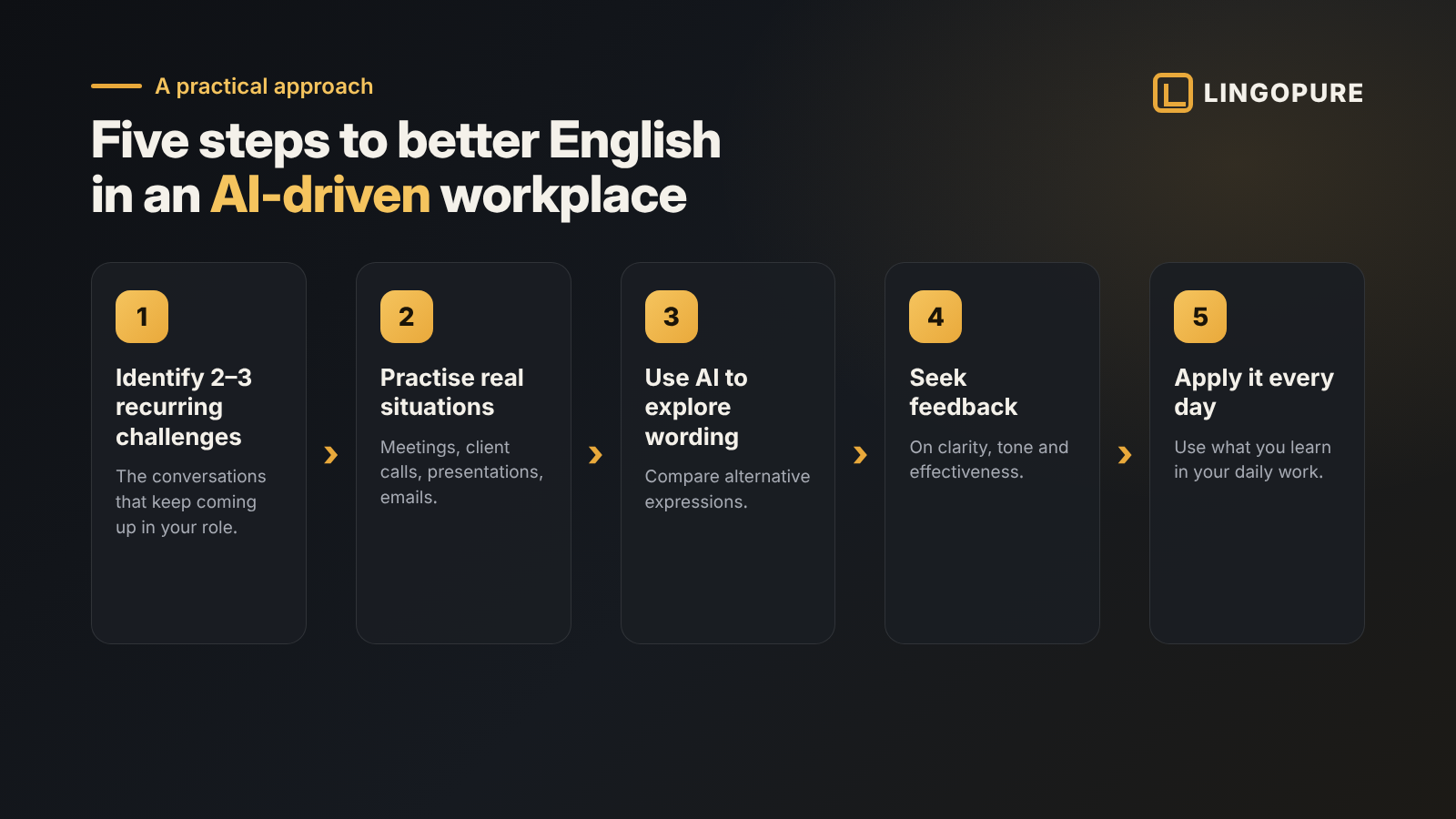
A useful approach is to:
- Identify two or three recurring communication challenges.
- Practise conversations based on real workplace situations.
- Use AI tools to explore alternative expressions.
- Seek feedback on clarity, tone and effectiveness.
- Apply what they learn in everyday work.
The objective is not perfect English in every situation.
It is the ability to communicate with greater clarity, confidence and purpose.
The Future of Work Needs Both AI Literacy and Human Communication
AI will continue to change how businesses operate.
Some routine communication tasks will become easier to automate, while employees may spend more time reviewing information, making decisions and managing relationships.
This does not mean every role will require the same level of English proficiency.
However, for professionals working in international environments, business English remains a valuable capability alongside digital and AI literacy.
The future of workplace communication is not simply about humans competing with machines.
It is about using technology effectively while strengthening the skills that help people work together.
Build Workplace Communication Skills With LingoPure
As international workplaces evolve, investing in practical English communication can help professionals prepare for new responsibilities and opportunities.
LingoPure helps learners focus on English communication for real-world professional situations, connecting language development with the challenges of modern work.
Whether you are an individual looking to communicate more confidently or an organisation exploring English development for your team, the next step starts with understanding your communication goals.
Ready to strengthen your business English skills?
Explore LingoPure's learning solutions and discover how practical English development can support your professional journey or your team's communication needs.
Visit LingoPure to learn more and explore your next step.
Frequently Asked Questions
Is business English still important in 2026?
Yes. AI can support translation and writing, but professionals still benefit from communicating clearly, participating in discussions and managing relationships in international workplaces.
Will AI replace the need to learn English?
AI may reduce the need for some routine translation and writing tasks. However, it does not eliminate the value of understanding context, tone and meaning during live professional interactions.
What business English skills should employees prioritise?
Clear communication, active listening, professional tone, meeting participation, presentations and negotiation skills are useful priorities, depending on the employee's role.
How can companies improve employees' business English?
Companies can identify role-specific communication challenges and provide opportunities to practise realistic workplace scenarios with feedback.
Can AI help professionals learn business English?
Yes. AI tools can support vocabulary practice, writing feedback, role-play preparation and conversation exercises. Human feedback and real-world practice remain valuable for developing contextual communication skills.
References
International Labour Organization (2026). Changing Landscape of Skills in the Age of AI
World Economic Forum (2025). Future of Jobs Report 2025
Microsoft (2025). 2025 Work Trend Index: The Year the Frontier Firm Is Born
Build the English you need at work
Start with a free assessment and identify the communication situations that deserve focused practice.
Book a free demo